CC: Wall Street, To Big To Fail Banks, Mainstream Media, Oil Companies, Natural Gas Industry, Monsanto, Nuclear Industry, Pharmaceutical Companies, Public Relations Firms, Military Contractors and your Corporate Government Accomplices.
Capitalism is endorsed as an economic system which promotes democracy and prosperity. These assertions are vehemently defended by capitalists and concepts such as supply and demand are even referred to as laws. Such notions are branded into the minds of Americans from birth and make it nearly impossible to critically discuss some of its flawed features. The very idea that this economic system might need to be altered or even ended, to fit the demands of a changing world, seems radical; for some, downright un-American. Nevertheless, without serious analysis into some of the extreme failures recently brought about due to population increases, mechanization and globalized trading trends, the basic needs of billions of people will not be met. Other complications, which are responsible for the current destruction of our planet and its life sustaining resources, have presented us with an ethical dilemma of monstrous proportions which can no longer be casually brushed aside or saved for a more convenient time.
The entire purpose of capitalism is to produce a good or service based upon a demand and continued growth of that business is expected to happen until the demand is met or subsides. Those that are most successful in a market will grow larger and larger and hire more and more workers and will require more and more natural resources to do so. In other words, growth is the truest measure of success under this system (and of course, excess capital will be gained for the effort by the capitalist).
This sounds really great if you don’t take into account several mounting problems which are quickly complicating this simplistic view of supply and demand capitalism. Firstly, our planet is finite and this literally means that we only have so much available landmass and water. That is fixed and can’t be changed. Technology may be able to change an environment to give us greater usage of the landmass but the actual area can’t be changed and this is already starting to present us with some real problems. Urban sprawl, for example, has swallowed up land that might be used for other purposes such as farming, or as a source for renewable resources, or might be used to maintain biodiversity.
As populations continue to increase, energy demands also rise which results in serious complications, including warfare. In order to meet these challenges and sustain a continued growth rate, energy providers will frequently encourage military intervention of their respective governments in order to secure deposits of rare earth minerals, gas and oil reserves. Other increasingly dangerous industry practices are frequently used, such as offshore drilling, which can have serious impacts upon the health of our oceans aquatic life and even disrupt the food chain. The recent catastrophic BP Gulf oil spill is a poster child for the severity of environmental damage that can occur from a single botched incident of industry that is legally bound to maximize profits.
Bigger corporations not only require more natural resources for continued growth but also can threaten the democratic will of the people and this inevitability is directly related to how capital organizes labor; as Einstein astutely noted…
Private capital tends to become concentrated in few hands, partly because of competition among the capitalists, and partly because technological development and the increasing division of labor encourage the formation of larger units of production at the expense of smaller ones. The result of these developments is an oligarchy of private capital the enormous power of which cannot be effectively checked even by a democratically organized political society. This is true since the members of legislative bodies are selected by political parties, largely financed or otherwise influenced by private capitalists who, for all practical purposes, separate the electorate from the legislature.
The consequence is that the representatives of the people do not in fact sufficiently protect the interests of the underprivileged sections of the population. Moreover, under existing conditions, private capitalists inevitably control, directly or indirectly, the main sources of information (press, radio, education). It is thus extremely difficult, and indeed in most cases quite impossible, for the individual citizen to come to objective conclusions and to make intelligent use of his political rights.
Concentrated wealth has always conflicted with the democratic will of the people because it accrues more political influence as it becomes bigger. The larger and more monopolistic a corporation becomes the more predatory it becomes to its own market and innovation in similar markets gets suppressed, which limits the choice of the consumer. Important markets to national security, such as energy, become intertwined with government and start to rely upon taxpayers money, such as subsidizes or tax cuts, in order to remain dominate. Alternative solutions and markets never see the light of day under such conditions and eventually corporatism results. All legislative and judicial measures start to morph into functions for corporate interests and corporate personhood is nothing short of the declaration by corporations of their newfound powers over we the people.
Mechanization must also be seriously considered as we think about economics and more specifically the functions of capitalism in today’s world. During the US industrial revolution populations were smaller and resources were plentiful. Capitalists made quick work of staking claims on natural resources and production monopolies soon developed which would later be trust-busted by the enactment of antitrust laws. As Senator John Sherman remarked…
“If we will not endure a king as a political power we should not endure a king over the production, transportation, and sale of any of the necessaries of life.”
Mechanization started to mean greater production of goods, which was fine, given the populations of the time and energy consumption needed to fulfill early industrial requirements. The notion of sustainability wasn’t important to early Americans as they tried to carve out a higher standard of living for themselves. Workers started to organize and fight for a greater say in how their working lives would be managed. Economic democracy wasn’t realized, but basic labor laws were achieved. The culmination of these events created a fledging middle class.
Tying it all together in modern times
In modern times, mechanization is a becoming a more complex issue. Firstly, it means the replacement of workers with machines which consume huge amounts of energy. As developing nations move into their own industrial age, such as India, the rate of needed resources climbs upward which encourages increasingly reckless practices of energy producers. It causes warfare, as more natural resources are needed by nations, because they have growing populations which consume more. To further complicate matters, other renewable energy sources developmental plans are undermined by oil and fossil fuel corporations which control governmental energy policy.
Globalized trade is proving itself to be a huge energy consumer as ships, planes, trains and trucks move goods across hundreds of miles. Simultaneously, it is responsible for driving down the living standards of workers who live in developed nations, as they try to match their developing nation counterparts’ poor labor standards and substandard environmental regulatory laws. As capitalism moves across the globe, under various governmental forms, it still has only one primary purpose and that is to create profit, profit and profit. The globalized picture is one of exploitation of resources and people alike.
Is this a sane way to manage our lives?
Millions of people across the globe are starting to recognize that something has gone horribly wrong with the way the modern world works. They understand that profits are being made off of the misery of others and that our Earth is being carved up by economic vultures. They realize that a proper economic system must provide for the needs of people first and take care of the Earth, which sustains all life. Such people are fighting for resource sustainability, not because they are irrational or aren’t sympathetic to those in need of work, but because they realize that we can’t keep consuming more and more on a finite planet. They are advancing the notion of a return to community ethics and local cooperatives which strengthen direct democracy and economic democracy. The time is upon us to finally realize what we have wanted all along, the ability to contribute the unique skillsets that each of us have to offer for the betterment of ourselves and our communities, to manage our own lives without unjust interference from others and to make sure that there will be enough left over for our children to do the same. We can do better.
He who rejects change is the architect of decay. The only human institution which rejects progress is the cemetery. ~ Harold Wilson
I have spent the last week pouring through information about Fukushima and administrating over the global petition to the UN, [cc: POTUS, NRC, Union of Concerned Scientists, Sen. Wydon and other Senators, Representatives and orgs], sending messages to high profile activists, entertainers and discussing with others in research groups, the best way to get information out quickly about this already life-altering disaster and what could possibly amount to the single most devastating event to all species on the planet as we know it.
What I have been struck by is the lack of self-preservation in regards to taking even the smallest action to create a tsunami of accountability to avert continued devastation. It’s like we’ve gone back in a time machine to the 1950’s and I’m stuck in the movie Pleasantville.
The news from Japan is frightening, infuriating and shocking. It is also familiar. The feelings I am experiencing are parallel to the ones many in the Gulf region of the United States have been through but on a scale times 10. Yet, I am calm enough to focus to do the best I can to get this information out simply because I have been in this position before and learned from it. Perhaps, on a spiritual level, have learned how to understand and cope with the devastating effects of the folly of man’s hubris.
Meditation helps…but I am still very angry. I honestly don’t know a soul who isn’t angry or offended or disgusted…and I’d like to add that these feelings ARE OKAY TO HAVE. We are human, we have feelings – a great ocean of them – and burying them solves nothing and serves no greater purpose to you or anyone you claim to love or want to protect, including yourself. Owning those feelings and focusing on constructive action is the only way to heal the planet – and ourselves.
Burying legitimate feelings is akin to burying the truth. They are there to serve as your warning bells. To ignore them is to ignore your intuition. And that, my friends is the exact goal of propaganda or PR. To make you question yourself and your good sense for a means to their ends.
I have chosen focused anger, warrior energy channeled into constructive action because at this point on my journey, at this time and place in history, it is literally all I know how to do. I look at this moment as THE biggest shift, the awakening of many – the realization of oneness – because this nuclear disaster can and will touch the lives of every single living thing on the planet.
You can’t get more connected or understand oneness of this magnitude – unless a comet were to come crashing down upon us and we knew in advance. We’d spend every moment doing exactly what we said we always wanted to do, tell people the things we always wished we could say, practice radical forgiveness, detachment from illusion and come together to open our hearts to the people we love. The only difference is that with Fukushima, something can still be done to stop future destruction because we DO have the information – a year’s worth and counting. We cannot reverse the damage already done in a year – but the possibility of saving the planet and every species still left on it, CAN occur with ACTION.
In regards to the moments of doing or saying those important things we said we always wanted? Do that, too…but first, understand that it will take your righteous action, global action to demand that constructive action be taken. There are brave people out there who would volunteer to save the world – but we first need to acknowledge the world is in peril. And unfortunately, the one thing standing in our way is, again, the hubris of man – to think he could contain a power as awesome as the sun…then lie about the fact that he can no longer contain it.
For what? The same things people of conscience fight against, occupy on behalf of and demand accountability for: Power, greed and control. Illusion. Samsara. The transitory. In the face of this disaster everyone will see, know and understand exactly how transitory these things are that we have spent eons hanging society’s values on. To our own detriment and the detriment of the planet we call home.
Hubris in History
Current history shows us we’re still battling an ages old problem – the inability of man to see his own folly in trying to control things that are simply beyond his capability to master. A friend of mine shared a song the other day – Godzilla, by Blue Oyster Cult – which in this instance may seem like callous jocularity to some, but there is a lyric within that song that speaks louder than most words I’ve heard uttered recently in regards to this situation: “History shows again and again / How nature points out the folly of men.“ Never a truer lyric was penned.
This is a time when we can make history – we are history, we are the shift – those who see nature pointing out the folly must let men know of their mistakes before they can learn from them. Right now, they are trapped in a bubble of their own illusions and if we don’t do everything within our power to burst that bubble, mankind could perish.
Take for instance the Cuban Missile Crisis – [source: Wiki] ”…one of major confrontations of the Cold War and generally regarded as the moment in which the Cold War came closest to turning into a nuclear conflict. It also marked the first documented instance of the threat of mutual assured destruction (MAD) being discussed as a determining factor in a major international arms agreement.“
I think we can all agree that MAD is a very appropriate acronym for the threat we face now if we don’t come to some international agreement to work together to avoid the same.
There are vast examples of hubris in history that would fill volumes in libraries stacked to reach to the moon. The ‘unsinkable’ Titanic comes to mind and has been aptly mentioned many times in regards to the same handling of our economy – that hubris has already hit an iceberg – and illustrates that the solutions to these larger global problems cannot be solved with money. The only sane choice is mutual action for the sake of self-preservation of our species, all species, rather than the current course of assured destruction.
If during the Cuban Missile Crisis, the global leadership recognized this basic truth about the future of mankind – it can be recognized and discussed again. This is, in essence, the duty and imperative role of leadership. If you recognize this, I put to you that it is also your duty and moral imperative to lead in this global discussion as well…
Nuclear age culture – Remember when?
Young people may not have a broad understanding of this age like their parents and grandparents certainly do. Many recall the old Hollywood movies that were part and parcel of the dawning of the nuclear age – films that served to warn mankind about this ‘mutually assured destruction’, albeit in a very fantastic way. The production of popular narrative films with nuclear topics largely conforms to periods of heightened nuclear awareness or fear, such as the fear of fallout from nuclear testing manifested in the atomic creatures in science fiction movies of the late 1950s. By their very numbers, and through a set of recurring stylistic and narrative conventions, nuclear films reflect a deep-seated cultural anxiety. The films have ranged in themes as they relate to the first atomic bombs (The Beginning of the End), to nuclear testing and fear of fallout (the Godzilla factor), to the Cold War arms race (Dr. Strangelove), to nuclear war (The Day After), and post-apocalypse (The Terminator). [1]
While this might be otherwise compelling in a nuke-free and safe world, it is currently frustrating as hell to those who remember – we appear to have missed the messages of not only the culture [Silkwood, The China Syndrome] but also history [Three Mile Island, Chernobyl] and have regressed once again back to an almost 1950’s mindset of being strangely comforted by those in leadership to not only think, “that couldn’t possibly happen” but worse…to actually believe “nuclear energy is safe” after all this time and after all the evidence glaringly dictates otherwise.
Art forms like film, can reflect our cultural climate throughout time and have historically reflected the underlying problems we face. This doesn’t happen often enough in the current film industry, in my opinion, simply because corporations, media and the military are involved in a lot of the debasing of our cultural currency as well. Yes, a bright, shiny gold or silver coin of a film slips through their cracks on glorious occasions….but the current nuclear industry PR is so pathetic in its inability to be honest about the dangers, especially when they avoid mention of the aged and failing infrastructure, that their reassurance means little to those who remember Three Mile Island and Chernobyl and have evolved well beyond the 1950’s mindset.
Acronym irony
Let’s do a comparison of what I’ll call the “Pleasantville” mindset* to the reality of disaster capitalism in a nuclear age. Take into consideration these recent quotes from two nuclear “experts” and compare them to the 1952 GE nuclear campaign claims in the PR film below. The idea here is to help you understand that the ‘official word’ is more often the ‘corporate’ word because of this addiction to growth and profit margins.
“The best place to be whenever there’s an earthquake is at the perimeter of a nuclear plant because they are designed so well.” − Ziggy Switkowski, 14 March, 2011, ABC
“There is no credible risk of a serious accident. The risk of meltdown is extremely small, and the death toll from any such accident, even if it occurred, will be zero. There will be no breach of containment and no release of radioactivity beyond, at the very most, some venting of mildly radioactive steam to relieve pressure. Those spreading FUD [fear, uncertainty and doubt] at the moment will be the ones left with egg on their faces. I am happy to be quoted forever after on the above if I am wrong … but I won’t be.“ − Prof. Barry Brook, Adelaide University
Although the “Atoms for Peace” campaign was formally launched in 1957, corporate America began to promote peaceful uses of atomic energy as early as the first few months after Hiroshima. A Is For Atom, an artifact of this effort, takes this highly loaded and threatening issue straight to the public in an attempt to “humanize” the figure of the atom. A Is For Atom speaks of five atomic “giants” which “man has released from within the atom’s heart”: the warrior and destroyer, the farmer, the healer, the engineer and the research worker. Each is pictured as a majestic, shimmering outline figure towering over the earth. “But all are within man’s power and subject to his command,“ says the narrator reassuringly, and our future depends “on man’s wisdom, on his firmness in the use of that power.” General Electric, a long-time manufacturer of electric appliances, power generation plants, and nuclear weapon components, is staking a claim here, asserting their interest in managing and exploiting this new and bewildering technology. Its pitch: this is powerful, frightening, near-apocalyptic technology, but managed with firmness, it can be profitable and promising. This “Trust us with the control of technology, and we’ll give you progress without end” pitch resembles what we’ve seen in films like General Motors’ ‘To New Horizons’ but the automobile, of course, wasn’t a weapon of mass destruction.
Note the ironic use of an acronym in the second quote above the film and the closing, “if I am wrong…but I won’t be.” Strange how the word ‘if’ even shows up at the end of a long-winded statement meant to quash uncertainty and doubt, isn’t it? It’s the end of that quote that says loudly, “I don’t speak for science, I’m speaking for industry.”
Scientists don’t deal in absolutes and would never be so cocky in the face of such awesome power that commands respect. As you can see by the claims from GE in the film synopsis, which sounds as if it were written by Ayn Rand on crack, to not hold nuclear power in cautious reverence is man’s folly – that is the ultimate in hubris. And knowing that is the key to being able to tell the difference between real science [which always seeks knowledge = understanding] and PR [which claims absolutes for a means to an end = profit]. Unfortunately, capitalism has turned into Godzilla and its lower-functioning brain does not recall that acronym: MAD. Naomi Klein coined the term “disaster capitalism” in her groundbreaking book, The Shock Doctrine. It is quite literally the closest cousin to Mutually Assured Destruction.
The destruction happening every minute in Fukushima is mutually assured unless we act now.
Energy is best focused on solutions. EPA is not doing it’s job nor are most government agencies who are charged with protecting the health and welfare of the people of this country. This problem is now global in scope as evidenced by the media blackouts in Japan. Agencies that we should be able to rely upon in situations of this magnitude, like the NRC, are now compromised by corporate infiltration. Press releases and conferences [more PR] are designed to keep you out of the loop, politics designed to make you feel ungrateful for this ‘clean energy’ solution they claim WE wanted, and as a consequence, we are ill-advised and unequipped to protect our own hide from the dangers that have already effected the ocean, the food chain, the west coast of the US and beyond.
Many of the people who realize the extent of the damage already done, know that at this point, we have ‘crossed a Rubicon’ and need to accept that we may be exposed to some amount of radiation already. We should use every tool we have [medicines, nutrition, homeopathy] to mitigate the effects of exposure. We need to stay committed to work, first and foremost, toward a global effort to help Japan with containment of Fukushima, with all the brilliant minds and might we have around the world – and then on to focus locally, following the lead of other nations like Germany, Switzerland and hopefully France, in safely shutting down all US nuclear plants.
Focus on mutually assured cooperation while we still have the resources and technology at hand.
The leaders, bankers and capitalists of the world wanted one kind of globalization.
Let’s show them they are getting quite another.
Do you see? It is our collective consciousness – our oneness – that is what they fear.
The more we understand and use this power, the better off we will all be.
Don’t underestimate it…
All our other work to help the planet won’t mean a thing when in one place sits enough material to destroy it if we do nothing.
Everything else we do is building sandcastles…until this is dealt with.
Please join us in signing the global petition to demand action at Fukushima.
Current addressees/recipients of the petition:
The President of the United StatesSen. Ron Wyden (OR)
Sen. Bernard Sanders (VT)
Rep. Dennis Kucinich (OH-10)
Rep. Edward Markey (MA-07)
Rep. John Conyers (MI-14)
Sen. Barbara Boxer (CA)
UN Secretary General Ban Ki-moon
U.S. Ambassador to the United Nations (Ambassador Susan Rice)
Chairman of the U.S. Nuclear Regulatory Commission (Gregory Jaczko)
Outreach Associate Union of Concerned Scientists (Chrissy Elles)
[This list is growing daily]
TRC is working overtime to create a page solely for Fukushima updates and to aggregate posts, data and links in one place.
[1] Source: Film and the Nuclear Age: Representing Cultural Anxiety (Garland Studies in American Popular History and Culture) http://www.powells.com/biblio?isbn=9780815329329
* This little golden coin of a film deserves an honorable mention and recommendation.
…drowning in paid opinions is more accurate…
Which leads us to…
We certainly aren’t paid to do this – so who benefits?
Can’t fight the “moneychangers” if you don’t know who they are…
And during election season – the disinfo goes to 11.
Turning off the TV is a good place to wrest some of your power back.
My personal solution 5 years ago was get rid of mine.
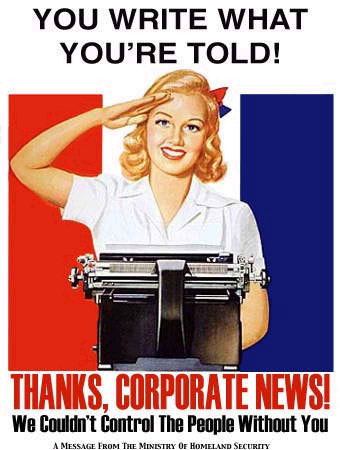
Whoever is at the end of your pointed finger isn’t the problem – your information is.
So stop getting it from monkeys in suits who are paid to press your buttons.
By the way, when you repeat what they say, you are easier to spot.
Equal parts blue and red…a parrot is a parrot.
Support indie media and you support brain food for democracy,
not finger-pointing, poo-throwing monkeys who are told what to say.
Labor is prior to, and independent of, capital. Capital is only the fruit of labor, and could never have existed if labor had not first existed. Labor is the superior of capital, and deserves much the higher consideration. ~ Abraham Lincoln
In the United States, class struggle isn’t a new concept but one which remains greatly ignored by our educational institutions and news media groups, alike. The consequences to our nation for the blatant disregard of this economic feature weaken the ability to effectively react to and organize against economic attacks made contrary to the working-classes’ best interest. What you don’t know can hurt you and comprehending the nature of class struggle is paramount to understanding the workings of the economy and one’s own role within it.
What we aren’t in short supply of, are the explanations about the importance of markets to our economy or how the laws of supply and demand are a central fixed feature to human activity. These buttresses of capitalism are relentlessly preached from every major media pulpit and are neatly interwoven with concepts of democracy, such that, the very notion that one can exist without the other seems impossible to the average American.
It’s the labor, stupid.
In the most basic sense, labor produces something of use; there is a tangible good or service provided which benefits a real economy. Resources are often the foundation of labor and must be considered an essential part of the economy. That tree (over there) becomes a table, should labor craft it into one, for example. Labor is superior to capital because it always advances the practical notion of a real world and one in which humans have physical needs. Labor’s primary function is to fulfill some kind of a need.
Capital, on the other hand, has managed to move beyond this basic concept of a real economy and the investments necessary to provide the goods and services needed by men and ventured into the territory of a false economy, through financialization. This new banking wizardry has manufactured a fictional economy which has become the equivalent of a parasite to the working-class. Investments no longer just support the furtherance of a real economy but often act counter to people’s well-being. Excessive speculation, for example, can drive up costs of raw materials well beyond the ability for them to be used in production or commodities can become priced out of the reach of the consumer and cause starvation and untold misery.
All of the past class struggles meant to elevate labor: workers safety protections, child labor laws, minimum wage standards, etc., which achieved a decent standard of living and developed a sizable middle class for the US, are now being undermined by this fictional banking world, which siphons wealth from the real economy and concentrates it into the hands of a few. The bankers of Wall Street have no intention to ease the suffering of the working-class in this inverted economy because labor’s financial loss is their immediate gain. Cutting benefit packages of workers, for example, can make the purchase of a corporate stock seem more attractive and steeply increase its value. Not only have these practices been responsible for aggregated wealth to the top 1% at unprecedented levels, they are also wrestling power away from the people and decimating the democratic process itself.
“They had begun to consider the Government of the United States as a mere appendage to their own affairs. We know now that Government by organized money is just as dangerous as Government by organized mob.” ~ FDR, 1936
The failure of government to intervene on behalf of labor to stop these practices has created an environment for finance capital to thrive over the last several decades: even as workers’ wages have stagnated since the 1970’s, even as millions have been tossed from their foreclosed homes, even as the dollar has weakened, even as millions have lost employment, even as millions have lost benefits, even as thousands fight and die in wars designed to secure more natural resources, even as they come after our social security insurance, even as they come after tax dollars set aside to help feed our needy and elderly, even as they dismantle US factories and ship them abroad, even as they let our family members die from lack of healthcare.
So when they tell you that this isn’t a class war, or that your labor is unimportant, or that you have to compete with a developing nation’s wages or benefits due to lackluster profit margins, or that the wealth will trickle down, or that the only way to balance a budget is on the backs of the working-class, or that we need to pay over 1 trillion a year for warfare, or that you’re Un-American for caring about your fellow countrymen’s general welfare, or that it’s unreasonable to feed the poor, or that banks are too big to fail and can’t be prosecuted for overt criminal activity, or to just go and find a job…when they tell you these things out of ignorance or smug indifference to the suffering of others; please remind them that this country was built with labor’s blood and sweat and that we have just as much a right to stake a claim in the way this nation operates and who will benefit from it, as they do. Tell them that change is going to come because we value what is real and that means each other.




 Gabracadabra Studios
You must be logged in to post a comment.