
Angela Richter is a theatre director and met Julian Assange in 2011 when she worked on a play about Wikileaks
This text is the English version of the German article “Endspiel für Assange” published in German weekly der Freitag (Issue 01/19)
Sidelined The theatre director Angela Richter visited WikiLeaks founder Julian Assange in Ecuador’s embassy in London. For the last time, she fears
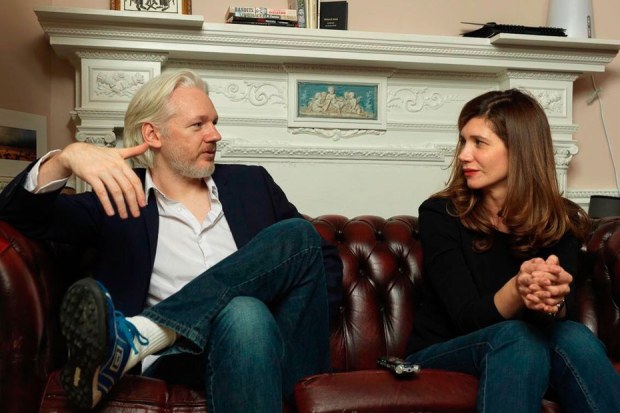
A photo was not possible in the embassy under the current circumstances. This one was taken during Angela Richter’s visit in 2014. Foto: Elfie Semotan
Julian Assange looks very pale. “Pale” isn’t quite accurate; his skin looks like parchment, almost translucent. He hasn’t seen the sun for almost seven years. He sits opposite to me in the so-called Meeting Room of the Ecuadorian Embassy in London, the snow-white hair, his trademark, is shoulder-length and he wears a long beard. We joke about him looking like Santa. He wears a thick down jacket and eats a piece of the sushi I brought for lunch. It is cold in the room and I regret that I left my winter coat at the reception.
It is just before Christmas, and Julian Assange has probably just had the worst time of his stay at the embassy. Since March 2018 he was de facto in isolation, no telephone, no internet and no visits. The internet ban must be particularly difficult for him; it was not only his field of work, but his only access to the world.
The mood in the embassy is tense; the new ambassador is due to arrive. They have turned off the heating and taken the bed, he sleeps on a yoga mat. I cannot help the impression that everything possible is being done to make his stay so difficult that he finally gives in and leaves the embassy voluntarily. But what will await him then?
It’s the first time since I’ve known him that he really looks drained, his former boyish face, which always seemed peculiar to the silver-white hair, has adapted to his age. The nine months of isolation have visibly weakened him, he has become leaner, but in our conversation he seems mentally strong and more determined than ever.
Surrounded by microphones
When I ask him how he had endured the isolation for so long, he replies that he was almost delighted at first. He was sure that such a flagrant violation of his human rights would cause great public outrage and European politicians would stand up for him because of pressure from the media. Nothing of the sort happened, however, and as the months passed, he lost faith.
In the meantime, it has even become public that the US authorities had filed criminal charges against Julian Assange. Charges that were supposed to remain under lock and key until Assange could no longer escape arrest. They confirm what Assange has feared for years and why he has often been declared paranoid in the press. But even after this revelation there is no indignation.
WikiLeaks
Since 2007, the disclosure platform has made it possible to publish documents anonymously. In 2010, it launched a video entitled Collateral Murder, which shows how civilians and journalists were killed in the attack by a US combat helicopter in Baghdad. In 2011, Wikileaks published 7,000 military documents on the incidents in Guantánamo. The platform attracted criticism when it published thousands of emails from the Democratic Party in the 2016 US election campaign. At the end of 2010 Sweden issued an international arrest warrant against Assange for “minor rape”. To avoid extradition, he fled to the Ecuadorian embassy in London in 2012. He fears that he will be tried for treason in the USA. Sweden closed the investigation in May 2017. In the USA, he allegedly has been charged.
His stay in the embassy, granted as political asylum in 2012, now resembles more and more a detention with rigid punishments. The isolation has still not been completely lifted, from Friday evening until Monday morning there is still a ban on contact, and anyone who wants to visit him has to submit a formal application to the embassy. There were probably also rejections, he tells me. I was lucky and got two of the requested four hours approved.
I have visited Julian Assange about 30 times between 2012 and 2017 at the Ecuadorian Embassy. This resulted in three theatre plays and a friendship with one of the most controversial people of our time. It was not always easy to defend him, especially since the election of Donald Trump as President of the USA, for which many journalists, former supporters and friends of mine have made him jointly responsible. Moreover, most journalists seem to have agreed that there is a mad conspiracy between Trump and Putin, with Assange as intermediary and helper. At the end of November, the Guardian claimed that Paul Manafort, head of Donald Trump’s presidential campaign, had met Assange three times in London: in 2013, 2015 and 2016. Fidel Narváez, the then Ecuadorian consul in London, has formally denied this. WikiLeaks initiated legal proceedings against the Guardian and Manafort publicly and denied the meetings. His name does not appear in the Ecuadorian Embassy’s guest book and there are no images of him entering or leaving one of the world’s best-monitored buildings.
Assange, of course, followed all this; when I ask him about it, he only says that the story in the Guardian is fictitious. As he enquires about my family and we eat sushi, we try to ignore that we are surrounded by cameras and microphones. Even in the small kitchen in the hallway there is now a camera installed, which used to be the only corner without surveillance where we sometimes withdrew. Recently, embassy staff has been changed one by one, the new staff doesn’t know Assange well, only the cleaning lady is the same. The diplomats who sympathised with him are no longer there.
As a distraction I unpack a few presents for him, German wholemeal bread he loves, fresh fruit, Ovaltine, a letter with a child’s drawing sent to him by my eldest son, and a Ukrainian sausage speciality from the Crimea that a friend and former dramaturg of Frank Castorf gave me. I try again to direct the conversation towards him and his precarious situation, but that proves difficult. I hardly know anyone who says “I” as reluctantly as Julian Assange, which is amazing considering how often he is described as a narcissist and an egomaniac.
Blueprint for all of us
It is difficult to describe the complex character of Assange. But one thing has become clear to me in recent years; it is simply not conveyable to the average intellectual. He is a meticulous archivist, a courageous revelator and uncompromising iconoclast, highly emotional and at the same time factual, alongside whom most of the artists and intellectuals I know seem like petty bourgeois who sell their personal neuroses profitably.
But if Assange is not the nefarious unsympath who is to blame for his own situation through his egomania, what does that mean in reverse? Isn’t he then a blueprint for all of us? What has happened to him for years in the middle of Europe shows what could happen to anyone who dares to raise his voice and reveal the truth about the powerful. Not in Russia or China, but in the free West.
Assange never gave up his credo “Let’s make trouble”. He tells me he hoped during the isolation that he could take a little “holiday from WikiLeaks”. But then everything fell asleep somehow; no one was keen to take the helm, which is not surprising when you see the consequences. He says he thinks his isolation was a test run for what would happen if he went to prison after all: WikiLeaks would probably disintegrate slowly.
I think he’s right. Since I have known Assange, I have realised that his organisation only exists because of his immense persistence. He often cheered me up with the sentence “Courage is contagious”. I can confirm this for myself; he has this effect that you feel encouraged to risk more. His insistence on the truth of documented facts has not brought him fame and glory; to the contrary. And yet he has never given up, I have experienced some ups and downs in recent years, I have talked with him and his team in the embassy for hours, sometimes nights, but also argued, laughed, eaten, drunk, sung and trembled.
Three ambassadors were replaced during this time, the fourth one just arrived in London on the day of my visit, and his main task will probably be to get rid of Assange as quickly as possible, with the least possible political damage to Ecuador’s image. The New York Times recently reported that there had been several talks in 2017 between Ecuadorian President Lenín Moreno and the now notorious Paul Manafort. Manafort had travelled to Quito to boost China’s investment in Ecuador. Allegedly, at the meeting with Moreno, there was also talk about Assange, about a deal to extradite Assange to the US in exchange for Ecuador’s debt relief. Assange jokes; wouldn’t it be ironic that the IMF, the International Monetary Fund, of all people, is now deciding on his future fate. He laughs, tormented, in the end the big money always wins. We notice that his persecution by the USA is no longer a secret, everything is open and nothing happens; It is exasperating.
In the end, it is actually four hours that I am there. When I say goodbye, we hug each other tightly, it might be the last time we see each other. Outside I also talk to some supporters who camp in front of the embassy with self-painted banners and lighted candles, they have been holding out for years, which I think is admirable.
On December 21, three days after my visit to the embassy, WikiLeaks publishes a shopping list: 16,000 procurement orders from US embassies around the world, including spy equipment. Julian Assange is online again. On the same day, the UN human rights experts of the Working Group on Arbitrary Detention (WGAD) reiterate their 2015 demand that Britain complies with its international obligations and immediately releases the founder of WikiLeaks from the Ecuadorian embassy into freedom. This could be done by guaranteeing him free passage, or at least guarantee that he will not be extradited to the US, after short detention in Britain.
So Assange’s fate is in the hands of the United Kingdom; the UK could easily end this blatant situation, but so far it has refused. Europe is silent about it. What else needs to happen for that to change?


 Gabracadabra Studios
You must be logged in to post a comment.