Occupying Fear and Loathing – A Foreword

by Gabrielle Price

This morning, a good friend of mine – one helluva Marine – sent me a link to check out.  He always sends me anything to do with Hunter S. Thompson as we are both fans [only one of us takes that a little far…though, I’ve read that imitation is the sincerest form of flattery].  I suppose it is a bit different for a woman to have such an affinity for a man known for womanizing, boozing and doping it up.

But Hunter was so much more than his carnal instincts – much more than most would perceive from a movie based on his book Fear and Loathing in Las Vegas.  He was a patriot, a serious lover of freedom and the constitution, and one of the best writers, and I believe commentators of a moment in time because of his higher instincts.  He was poised at the edge of a political world on the verge of losing it’s ever-loving mind.  He was passionate.  And sometimes that passion was mistaken for hatred, or anger – though, he had plenty of reasons to be angry – like the rest of us.  I think that’s why he always resonated with me.  He was able to say, without apology, how he felt about what he saw happening to this country…and he purged his disgust and anger in a way that made me feel relieved afterward.  He said it for me – I didn’t have to – and ladies don’t talk like that, dont’cha know?

I come from a family that has its roots in both Virginia and Kentucky [where HST hailed from]. Hunter’s colorful language and flair for humorous descriptions and people, made his writing feel as if I had just sat on the front porch with him and spun yarns over a few beers.  I’ve been told for years that when I am angry, a bit of a southern drawl creeps in and that my writing style can only be described as Gonzo.  I never really embraced that until after he was gone and I began writing during the “stolen term” of the Bush Administration.  9/11 was a very hard time for a lot of people and Hunter spoke a lot about this.  It was really hard for me to see him go in 2005…but there was no need for me to ‘go Gonzo’ when his work was there for all to read.  I thought, who the fuck was I to pick up that baton?  There are other journos out there telling it like it is – maybe even humorous Kentucky colonels covering politics?

Turned out, not so much…but I often imagined what he might say even though I lacked a few colors from his marvelous verbal palette.

Even in 2005, I was terribly naive about a lot of things that he wrote about [i.e. foreign policy, militarism] and I had some learning to do.  LOTS of research if I was going to have the audacity to put those hat and glasses on.

By 2008, when Bush was finally leaving – politics got more personal and just uglier than hell.  I understood more and more…but I didn’t write often about issues when I worked on my music project.  THEN the BP oil spill happened and I got fired up again.  Then I learned about peak oil and sat my ass right back down to study.  Nowadays, I see the political landscape from a safe distance [for my health and to maintain any friendships…agreeing to disagree doesn’t happen like it used to] and I wonder what Doc would have to say about this whole mess.

Then I figure he kinda already did say everything he wanted to say [or could say] about what he knew and saw and got the fuck out while the getting was good.  Wish he could have been here to see Occupy…

I’ve had days where I thought I was going to be done with writing altogether in these last few weeks…just ready to chuck it all in.  Trying to figure out how the hell to share peak oil information that would make grown men with muscle cars weep in a puddle of piss, and make Ikea shoppers go to addiction groups to deal with never being able to buy Swiss-modern petroleum based plastic everything from cups to shitty wall art.  Like Tyler Durden said, “Martha Stewart is polishing brass on the Titanic…it’s going down, man.”

I thought about this recent media trip, Occupy Fear and Loathing – which ended up nothing at all like what was intended; loss of footage, a camera, several missed interviews, didn’t get home for Christmas, a piece of shit truck with no stereo, a nightmare of a travel partner who couldn’t even pump gas who left me stranded in Phoenix…and who still has my documentary footage.

I wondered what the fuck point is there in writing about the trip or anything at all.  And just when I thought I couldn’t stand to read another link…

We come back to this morning’s message with this link that was shared with me.  A report from the Los Angeles Review of Books, called “Love, Boxing and Hunter S. Thompson.”  In the beginning of the report is a synopsis where one of the authors mentions two books – for my purposes, I will mention only the one – and thank the author and my friend from the bottom of my Gonzo heart.

Tom Lutz – “Fear and Loathing in Las Vegas […] colossal failure of mission, spectacular performance of the art of being sidetracked, of being shanghaied by errant attention, or, perhaps, [a] perfect example of the way art is, at its best, a perversion, a turning away from more straightforward intentions.
Ho ho!  Res ipsa loquitur.  Let the good times roll.
Rest in peace, Doc.  I got this.


~~~~~~~~~~
“I shared a vagrant optimism that some of us were making real progress, that we had taken an honest road, and that the best of us would inevitably make it over the top.  At the same time, I shared a dark suspicion that the life we were leading was a lost cause, that we were all actors, kidding ourselves along on a senseless odyssey.  It was the tension between these two poles — a restless idealism on one hand and a sense of impending doom on the other — that kept me going.” ~ Hunter S. Thompson / The Rum Diary (1993)
500ed-americosmos
Occupy your fear.
Then let it go.

A Simple Exercise

Official Excerpt from Crossing the Rubicon: The Decline of the American Empire at the End of the Age of Oil

by Michael C. Ruppert

Take a 20-dollar bill out of your wallet and set it in front of you.  Now take a glass of water and set it next to the cash.  Pretend that the glass of water represents a barrel of oil.  Look at them both for a second.  Then ask yourself a question:  What do they represent?  If you keep distilling your answers down to their purest essence, you will see that the money and the oil both represent the same thing: the ability to do work.  Both are useless if there is nothing to buy, drive or eat.
And yet our economic system, what we call capitalism but which is really something else, is predicated on debt, fractional reserve banking, derivative financing, and fiat currency. Therefore it requires that there must be limitless growth into infinity for it to survive.  Growth is not possible without energy.
Now look at the barrel of oil and realize that the earth is a closed sphere, and that without the oil and natural gas, the financial system is doomed.  There is nothing on our horizon – other than wishful thinking – that can completely replace hydrocarbon energy.  The surest way to see this is to realize that, as the human race starts down the inevitable slope of shrinking oil and gas supplies, we have seen no hydrogen powered F 18 Hornets or M1 Abrams tanks.  We have seen no vegetable oil-powered Bradley fighting vehicles or solar powered guided missile frigates.
There are many factors that the rulers of the American empire now have to manage as they read their own delusional map of the world.  They have to:
  • Apportion dwindling resources among competitors, some of whom possess nuclear weapons;
  • Maintain and expand their control over enough of the oil and gas remaining to ensure their global dominance and maintain order among the citizens of the Empire;
  • Simultaneously manage a global economic system, made possible by hydrocarbon energy, that is collapsing and in which the growing population is demanding more things that can only be supplied by using still more hydrocarbon energy;
  • Acknowledge that they cannot save their own economy without selling more of these products;
  • Control the exploding demand for oil and gas through engineered recessions and wars that break national economies;
  • Hide the evidence that they are systematically looting the wealth of all people on the planet – even their own people – in order to maintain control;
  • Maintain a secret revenue stream to provide enough off-the-books capital for purposes of providing themselves a distinct economic and military advantage, improving their technological posture, and funding covert operations;
  • Repress any dissent and head off any exposure of their actions;
  • Convince the population that they are honorable;
  • Kill off enough of the world’s population so that they can maintain control after oil supplies have dwindled to the point of energy starvation.
In the case of the War on Drugs, I infer that the result of some 30 years of effort, fueled by billions of dollars and managed by the “best and the brightest,” is exactly what was intended.  This is the premise from which I began looking at the events of September, 11, 2001, as I watched the second airliner hit the World Trade Center.
I do not claim to have presented or reconciled every fact.  That rarely happens in a complicated homicide investigation.  The tasks of the investigator are to produce a reasonable explanation based upon evidence that establishes probability, and to eliminate reasonable doubt that a crime was committed and that the guilty have been successfully identified.

If I can make a case in this book that explains these events, identifies the suspects, and makes more sense than any other interpretation of the available and demonstrable facts; if I can then get it out in a way that further empowers our collective learning; if that helps to break down the destructively false paradigm that governs so much of our life today – then I have contributed something that is hope-giving for all of us.  Otherwise, the future looks pretty grim.  This is a race against time.

Michael C. Ruppert ~ April, 21, 2004
Got lifeboat?
The Refreshment Center is home of the
Official Excerpts from Crossing The Rubicon

Petroleum Man

Excerpt from Crossing the Rubicon: The Decline of the American Empire at the End of the Age of Oil, pub. 2004 / Chapter One, “Petroleum Man”

by Michael C. Ruppert

Global demand for oil and natural gas is growing faster than new supplies are being found, and the world population is exploding.  Currently the world uses between four and six barrels of oil for every new barrel that it finds, and the trend is getting worse. [1]  Natural gas use is exploding while the rate of new gas discoveries (especially on the North American continent) is plunging. [2]

According to most experts – including Colin Campbell, on the the world’s foremost oil experts with decades of experience as senior geologist, in upper management, and executive positions with companies including BP, Amoco, FINA, and Texaco – there are only about one trillion barrels of accessible conventional oil remaining on the planet. [3]  Presently the world uses approximately 82 mb/d (million barrels per day).  Even if demand remained unchanged, which it clearly will not, that would mean that the world will run out of conventional oil withing thirty-five years.  Oil, however, does not flow like water from a bottle.  Since the world’s population and the demand for oil and natural gas are increasing rapidly, by reasonable estimates, the world supply of conventional oil is limited to perhaps 20 years.  It’s a common mistake to assume that oil will flow in a steady stream and then suddenly stop one day.  Instead, the stream will gradually diminish in volume, with occasional small increases, even as the number of people “drinking” from that stream, and the amount they consume explodes.

[Gabrielle : When Mike mentions “drinking” from the oil stream, I am always reminded of Daniel Plainview in There Will Be Blood, when he refers to the oil under his neighbor’s land as a ‘milkshake’ that he ‘drank’ right out from under the neighbor.  We all know how we get the milkshakes now.]

Other issues compound the problem.  As fields deplete, oil becomes increasingly expensive to produce.  These costs must be passed on to consumers.

Not all oil in the ground is recoverable.  When it takes more energy to pump a barrel of oil than is obtained by burning it, the field is considered dead, regardless of how much oil remains.  Unconventional substitutes are extremely expensive and problematic to produce.  Tar sands, oil shale, deep water, and polar oil sources have severe limitations.  Canadian tar sands development is proving disappointing because it requires large quantities of fresh water and natural gas to make them steam, which is a necessary part of the extraction process.  Natural gas cost and fresh water shortages are already limiting production, and the material costs for the energy needed to make the energy have already begun to curtail production.

The same problems afflict the development of shale, deep water, and polar reserves.  They are currently too expensive to develop in quantity, and when exceptions arise, they’re too small to mitigate Peak Oil.  Even the best-case “fantasy” scenarios for these energy sources don’t change the picture much.  To learn more about this I recommend two web sites: www.peakoil.net, and www.hubbertpeak.com.

I’m capitalizing the phrase “Peak Oil” to indicate that it’s a historical event.  It’s an unavoidable, utterly transformative crisis, and an increasing body of evidence suggests two major consequences.  I’ll state them here in the starkest terms; later I’ll add reassuring qualifiers and a few formulations that might be more palatable.  But it comes to this:  first, in order to prevent the extinction of the human race, the world’s population must be reduced by as many as four billion people.  Second, especially since 9/11, this reality has been secretly accepted and is being acted upon by world leaders.  In this chapter I marshal the evidence for this disturbing pair of hypotheses which, taken together, constitute the ultimate motive for the attacks on September, 11, 2001.

What have hydrocarbons done for you lately?
Oil and natural gas are close cousins.  In nature the two are often found very close together because they can originate from the same geologic processes, under conditions that have existed only rarely in the Earth’s four-billion-year history.  Oil and gas are hydrocarbons that come from dead algae and other plant life.  There are biological traces in oil that proving that it came from living matter. [4]  Since the earth is a closed biosphere, oil and gas are finite, non-renewable resources.  The world has used half (if not more) of all the hydrocarbons created over millions of years in just about one hundred years. [5]

According to Richard Duncan, PhD in 1999 approximately 95 percent of all transportation was powered by oil.  And 50 percent of all oil produced is used for transportation purposes.  No other energy source even comes close to oil’s convenience, power, and efficiency. [6]

Oil pervades our civilization; it is all around you.  The shell for your computer is made from it.  Your food comes wrapped in it.  You brush your hair and teeth with it.  There’s probably some in your shampoo, and most certainly its container.  Your children’s toys are made from it.  You take your trash out in it.  It makes your clothes soft in the dryer.  As you change the channels with the TV remote you hold it in your hands.  Some of your furniture is probably made with it.  It is everywhere inside your car.  It is used in both the asphalt you drive on and the tires that meet the road.  It probably covers the windows in your home.  When you have surgery, the anesthesiologist slides it down your esophagus.  Your prescription medicine is contained in it.  Your bartender sprays the mixer for your drink through it.  Oh yes, and the healthy water you carry around with you comes packaged in it.

Be careful.  If you decide that you want to throw this book out, your trashcan is probably made from it.  And if you want to call and tell me what a scaremonger I am, you will be holding it in your hands as you dial.  And if you wear corrective lenses, you will probably be looking through it as you write down a number with a pen that is made from it.  Plastic is a petroleum product, and its price is every bit as sensitive to supply shortages as gasoline.  Oil companies do not charge a significantly different price for oil they sell to a plastics company than they charge a gas station owner.  If the wellhead price goes up, then every downstream use is affected.

If you live in the United States and the power generating station that serves your community was built within the last 25 years, natural gas is probably providing the electricity that powers the bulb illuminating this book.  According to figures supplied by the US government, some 90 percent of all new electrical generating stations will be gas powered.  Vice President Cheney’s “energy task force,” the National Energy Policy Development Group (NEPDG), stated in summer 2011 that “to meet projected demand over the next two decades, America mus have in place between 1,300 and 1.900 new electric plants.  Much of this new generation will be fueled by natural gas.” [7]

[G: Of course, we all know which company could be considered the largest in natural gas hydrofracking; who previously owned it…and now claims to have no ties to it.]

Oil is also critical for our food supply.  Quantitatively speaking, modern food production consumes ten calories of energy for every calorie contained in the food. [8]  When the farmer (or more likely the “agribusiness employee) goes out to plant seeds, he drives a vehicle powered by oil.  After planting he sprays the crop with fertilizers made from ammonia, which comes from natural gas.  Then he sprays them several times with pesticides made from oil.  He irrigates the crops with water that most likely has also been pumped by electricity generated by coal, oil, or gas.  Oil powers the harvest, transportation to processing plant, processing, refrigeration, and transport to the grocery store (to which you, the consumer, drive an oil-powered vehicle).

You may pay for it with a piece of oil that you carry around in your wallet.  Then you may take it home, cook it by means of either electricity or natural gas, and eat it or place it on a plate that may have been made from oil, after which you wash the plate with a synthetic sponge that is also made of oil.

Consider this:  out of six and a half billion people*, there are about 4 billion who don’t have, and who want, all of the things I have just described.  The current world economy is inherently committed to endless growth, and while physically impossible, this illusion is to be chased after by driving the poor countries into a globalized market for cheap goods.  Haiti, for instance, has had its domestic rice farming ruined by American export dumping.  When the Haitian farmers could no longer underbid the American rice in Haitian markets, they moved off the land and became unemployed.  Then the Americans raised the rice prices to crippling levels.  So Haiti is a captive market, but it’s a market nonetheless.  Similar developing countries are slowly acquiring more purchasing power and the industrialized world is gaining a foothold in their domestic economies by targeting them for cheap exports.  One way or another, the have-nots must become consumers.  [* Note that just last year, the world population reached 7 billion.]

Food
How important are hydrocarbons to food production?  One recognized oil expert puts it this way:  “If the fertilizers, partial irrigation, and pesticides were withdrawn, corn yields, for example, would drop from 130 bushels per acre to about 30 bushels.” [9]  That’s bad news in more ways than you can think.  The same applies in varying degrees to any crop:  wheat, alfalfa, lettuce, celery, onions, tomatoes; anything that commercial agriculture produces.  Oil and gas are irreplaceable if the world is to continue pumping out enough food to feed 6.5 billion people.  And that says nothing about the additional 2.5 billion that are projected to be here before the middle of this century.  Organic farming or permaculture is responsible and respectful of nature and may ultimately be nearly as productive as hydrocarbon-based agriculture.  But the infrastructure is not in place to implement it. [G: This is very true on a large scale – but please, do think local.]  You could ask several billion people to stop eating for a year or two while we switch over and work out the bugs.  Do you want to volunteer?  Would you volunteer your children?

So what about all the beef cattle, pigs, and chickens that feed on grain and corn?  Would you be prepared to pay $50 for a Big Mac if there were severe grain shortages?  How about a $25 chicken breast?  That would be a quality problem for an American, as opposed to someone in Africa or Asia who lived off crops and food products sold by globalized agriculture in case there was nothing locally grown.  You have always been told that these people just weren’t as productive as we are.  It’s not true; they don’t have the oil and natural gas that we do.  The United States contains 5 percent of the world’s population and currently consumes 25 percent of the world’s energy. [10]

Growth
Oil also powers more than 600 million vehicles worldwide. [11]  Would you pay for a $50,000 car and pay $5 a gallon for gas?  $10 a gallon?  Could you?  In the current financial paradigm, the stability of the world’s economy depends on growing revenues through the sale of more and more vehicles and other products that are useless without hydrocarbons.  The revenues generated by current customers in developed countries won’t be enough to sustain future growth, so cars and computers and air conditioners are beginning to flow into the new markets of China, Asia and Africa.  Those populations don’t have these energy-guzzling machines (nor the myriad petroleum-derived consumer goods enjoyed in the relatively high-wage countries), but they quite clearly desire them – especially the younger generation, whose purchasing power is growing at the fastest rate.  As their economies grow more robust, wages rise and the consumers’ desire becomes actual economic demand.

For the moment, much of the developing world remains ravaged by massive, artificially engineered debt to the World Bank and the IMF [International Monetary Fund].  But rising literacy rates and the correlative falling birthrates in many regions promise a massive expansion in consumer spending. [12]  And this has already begun:  Chinese auto sales are exploding.  According to one report, 2002 Chinese auto sales jumped by more than 50 percent. [13]  GM’s auto sales in China jumped by 300 percent in 2002 alone. [14]  If there is no growth in revenue for the corporations that make and sell these things, then what is left of your 401(k) plan will be worthless.  And you might even be out of a job yourself. [G: Keep in mind this WAS published in 2004…you don’t have to wonder why I am typing these words.  Since the crash in 08, much of what is in this book has come to pass. Quite rapidly.]

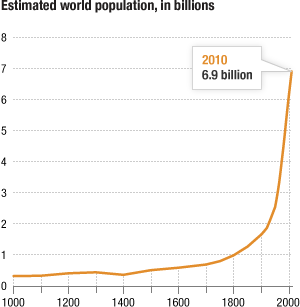
Colin Campbell had rightly identified a subspecies of Homo sapiens that he calls Petroleum Man.  He provided me with this population graph that shows the effect of hydrocarbons on the planet since their introduction.  The little dip around 1400 was caused by the bubonic plague. [15] [G: Forgive me, as I couldn’t find the exact graph from Rubicon online – but this NPR graph is practically identical, so I share it here instead.]

A number of environmentalists have been sanely and prophetically decrying the destruction of the biosphere for decades.  This is another key part of the equation.  They have pointed to alternative energy supplies such as wind, solar, geothermal, and biomass as steps toward protecting the ecosystem.  But very few understand the infrastructural problem that must be addressed if the crisis is to be solved in any rational matter. [G: Mike has already stated that it is too late and I agree with that assessment.  We’ve had windows open but they are slamming closed now.]  Peak Oil will likely turn human civilization inside out before global warming does, unless – and there are signs that this is happening – oil and gas shortages elicit a tragically shortsighted return to coal.

Given the hundreds of thousands of non-combatant deaths in the resource wars of Afghanistan, Iraq, and so many other places; given the deaths in Europe and Asia from extreme weather conditions in both summer and winter months; given the murderous, smoldering conflict in Nigeria and other oil-rich countries where corporate power combines with forces of local warlords; given all of this, Peak Oil is killing us now.  That, and the argument that these are the merest hints of what Peak Oil is going to bring, is the message of this book.

~~~~~~~~~~~~~~~~~~~

Many thanks to Mike for permission to share excerpts from his incredibly prescient and historical book.

G: I suggest you buy a copy now and catch up.  If you have been reading the stories and articles I have shared with you here and on Facebook, Twitter and want to jump into Mike’s current assessment of news and intel that I get on a daily basis, I suggest a membership to Collapsenet.  There are three ways to join.  One month is straight up $10. Peruse the site and if like it, you can create a recurring $10 monthly subscription.  A lifetime membership is $1000, which has to be mailed in.  For my readers, if you click on the Zombie flyer or World clock flyer and enter code 160, you’ll get a discount.  You can also become an affiliate and get paid to save lives while there is time to do so.  You do not have to have a membership to be an affiliate.  It is the most important work I’ve ever done.  I sleep better knowing my path to permaculture course study is closer and will provide a secure role for myself and my family in a post-carbon future, because of Mike and his team’s unfailing commitment to truth and an informed citizenry.

Please find footnotes to this chapter excerpt below.


~~~~~~~~~~~~~~~~~~~
[1] “The world now uses about 26 billion barrels of oil a year, but, in new field discoveries we are finding less than six billion.” Walter Youngquist, “The Post Petroleum Paradigm,” in Population and Environment, Vol. 20, no. 4, (March 1999); Colin Campbell, founder of the Association for the Study of Peak Oil, JPMorgan Chase investor conference call, April 7, 2004, www.mnforsustain.org/youngquist_w_post_petroleum_and_population.htm
[2] Dale Allen Pfeiffer, “Leaping off the Natural Gas Cliff (And a Word Concerning Foolishness of Ethanol),” in FTW, June 21, 2002, www.fromthewilderness.net/free/ww3/062102_gascliff.html
[3] National Energy Policy (NEP), “Chapter 1: Taking Stock: Energy Challenges Facing the United States,” www.whitehouse.gov/energy/Chapter1.pdf [Note: page not found]
[4] Interview with Colin Campbell, FTW, October 23, 2002, www.fromthewilderness.net/free/ww3/102302_campbell.html; cf. http://www.istp.murdoch.edu.au/publications/projects/oilfleay/03worldoilgas.html [Note: page not  found]
[5] Dale Pfeiffer, “The Background is Oil”, FTW, December 18, 2001, www.fromthewilderness.net/free/ww3/dec2001_files/background_is_oil.html
[6] Richard C. Duncan, “The Peak of World Oil Production and the Road to the Olduvai Gorge”, www.hubbertpeak.com/Duncan/olduvai2000.htm
[7] National Energy Policy, “Overview”, op. cit.
[8] Patrick Whitfield, Permaculture in a Nutshell, Permanent Publications, 1993, p. 1.
[9] Walter Youngquist, “The Post-Petroleum Paradigm – and Population” in Population and Environment: A Journal of Interdisciplinary Studies, Vol. 20, no. 4, March 1999, http://www.dieoff.org/page171.htm
[10] National Energy Policy (NEP), “Chapter 8: Strengthening Global Alliances”, www.whitehouse.gov/energy/chapter8.pdf [Note: page not found]
[11] Youngquist, op. cit.
[12] See Emmanuel Todd, After The Empire: The Breakdown of the American Order, (European Perspectives: A Series In Social Thought And Cultural Criticism), Columbia University Press, February, 2004
[13] Ibid.
[14] Ibid.
[15] Colin Campbell, “Peak Oil: A Turning Point for Mankind,” (lecture a the Technical University of Clausthal, Germany), www.oilcrisis.com/campbell/
Want brass tacks and bottom lines?
Chief Oren Lyons cuts to the chase: Value change For Survival

A Matter of Life and Death

Foreword excerpt from the book Crossing The Rubicon ~ The Decline Of The American Empire At The End of The Age Of Oil by Michael C. Ruppert / published 2004

Shared with permission from Mr. Ruppert

The real deal on corporate media

by Catherine Austin Fitts

In 1990, a New York Times reporter writing about my work implementing financial transparency and controls as an Assistant Secretary in the first Bush administration resigned to prevent the Times’ Washington Bureau Chief from intentionally falsifying the story.  The bureau chief kept his job, a first rate investigative reporter left the news profession, and the story was buried.  This manipulation protected 1980’s black budget fraud at the US Department of Housing and Urban Development (“HUD”).  It was one of my many lessons on the economic interests and political loyalties of corporate media.
Indeed, during the 1980’s, the savings and loan industry and government insurance programs were stripped of an estimated $500 billion by syndicates of military, intelligence, and private financial interests.  The profits were used to buy up banking, industrial, and media companies and to finance political campaigns.  From a greater position of political, judicial, and economic power in the 1990’s, these same syndicates then stripped an estimated $6 trillion of investors’ value in pump and dump stock market and mortgage market schemes and an estimated $4 trillion of taxpayer money from the US federal government.
In 1997, the Washington Post killed a cover story on my efforts to help HUD insure the integrity of its mortgage programs, thus making possible the subsequent disappearance of $59 billion from HUD as a part of this orgy of “piratization” of government assets by private interests.  Soon thereafter, when I attended a private invitation-only reception with colleagues at her home, Katherine Graham, the owner of the Washington Post, snubbed me by refusing to greet me in her receiving line.
Washington Post corporate interests profited from HUD programs used to gentrify Washington, DC neighborhoods.  Check out the last few pages in Graham’s autobiography – it’s there in black and white.  What’s not to be found in the pages of the Washington Post or Graham’s book is the “real deal” on who has profited from insider real estate development or narcotics trafficking in these same Washington neighborhoods – or from reinvestment of the resulting profits in stocks of local corporations like the Washington Post.
 
I do not mean to single out the New York Times or the Washington Post.  I have had similar experiences with the Washington Times, the Wall Street Journal, US News and World Report and Dow Jones Newswire, to name a few.  Trusted friends and colleagues have experienced similar situations with numerous newspapers, magazines, and networks owned and operated by corporate media interests.

George Orwell once said that omission is the greatest form of lie.  That’s the best description I knew of corporate media today.


The growing power of media
The cost to you of supporting corporate media is not just the subscription prices or the time lost to advertisements.  It’s the cost of omission – failing to tell you what you need to know.  Consider that this cost includes:
–  Your share of the $10 trillion that has been moved out of the US stock market and government without your having been informed by an alert and objective news media in time for you to take actions to protect yourself and your family.
–  The dilution of your Constitutional freedoms and the vesting of power in a small group of individuals who defraud you (the public) of staggering sums of money and then use that money to buy up media and control your government and judiciary and to compromise your rights and the rights of the people around you.
–  The impact on you and your children of having your streets and schools overwhelmed with dangerous narcotics and prescription drugs.
Our financial system depends on liquidity.  In turn, liquidity depends on a popular faith in the system’s “rule of law.”  Global leadership’s power depends on the ability to combine criminal cash flows with liquid stock market and government securities.  This is why Mike Ruppert’s From The Wilderness [and currently Collapsenet.com] and a growing global network of Internet media are accomplishing so much as we shift our readership and subscription dollars to them.  The powers that be are highly motivated to protect the legitimacy of their financial system.  If a little bit of well-placed illumination exposes some of this criminality, the criminals take notice.  That little bit of illumination can also embarrass them a lot in front of their families and neighbors.  Who wants to go to a PTA meeting after Mike Ruppert has explained that you are on the board of, or a lead investor in, a company complicit in slave trafficking or the torture of children?
David can defeat Goliath if we provide the resources to finance the stones – as you have helped do by buying this book.
The record speaks for itself
The fact that America and many countries around the globe are being strip-mined in a manner that results in the destruction and “piratization” of our infrastructure and natural resources, the reduction of the value of our personal assets and retirement and health care benefits and the abrogation of our civil liberties is not something that the corporate media has made clear to you. Mike Ruppert has.
Allegations that the CIA and Department of Justice were partnered with George H. W. Bush and Oliver North through the offices of the National Security Council in a little Iran-Contra arms and cocaine trafficking operation in Mena, Arkansas; and that Hillary Clinton’s law firm was helping launder the local share of the profits through state housing agency securities and investments were never addressed objectively by corporate media.  Mike Ruppert covered these stories and broke the story of the possible connection between these allegations and the Clinton impeachment.

It is highly unlikely that you read or heard in the corporate media that the price of gold was being manipulated to turn off our financial “smoke alarm,” or to “piratize” significant inventories of gold out of government and central banks globally at suppressed values.  It is highly unlikely that you read or heard that money was allegedly being siphoned off from federal agencies using PROMIS-type software programs and that important financial securities and investigation records were destroyed in the Oklahoma City and 9/11 attacks.  Mike Ruppert’s subscribers have read these stories.

You did not read or hear in the corporate media that the events of 9/11 “just happened” to resolve a stalemate in the defense appropriations subcommittee created when, in the face of the “disappearance” of $3.3 trillion from the Department of Defense and a five-year refusal to produce audited financial statements, Congress was challenged with achieving a significant increase in defense spending.  Or that the events of 9/11 allowed the Federal Reserve to adopt highly inflationary monetary policies that postponed dealing with serious financial system flaws.  Mike Ruppert covered these stories.

You did not read or hear in the corporate media that our lives and economy are entirely dependent on fossil fuel, that world oil and gas production will soon decline, and what these facts have to do with the events of 9/11 and the subsequent invasions of Afghanistan and Iraq.  Mike Ruppert covered these stories.

All these facts and allegations have been made abundantly clear by Mike and his publication From The Wilderness.  While corporate media refines the art of profitable omission, Mike Ruppert has risked his name, his financial security, and his life to warn us – again and again.

[Gabrielle again – I need to explain that Mike’s site From the Wilderness is archived and still available for anyone to view and search through.  I’ve used it many times to vet information because Mike’s work is solid – the kind of work I strive to do.  The reason why I am sharing this is so you will understand the historical importance of his book, Crossing the Rubicon and that membership to his site could now, quite literally, save your life.  We all see what’s going on in the new media now – the crackdown on protesters, the signing of the treasonous NDAA bill, the rising cost of fuel, and the tensions now rising with the US and Iran.  Mike predicted damn near everything that’s happening.  Get a membership to get your finger on the pulse of the world – and protect yourself.  Your government isn’t going to do it.  Back to the excerpt…]

An info cop’s beat: Watching your back

Through his website, radio talk-show appearances, speeches, DVDs, monthly newsletter, and email updates, Mike has been telling us for years what he sees, hears, and feels about “the real deal.”

Mike Ruppert had to leave the Los Angeles Police Department because he tried to prevent government-protected narcotics trafficking.  After learning that the corporate media would not tell the truth about this important story, Mike became a publisher.  In the face of widespread public denial of the fact of our economic dependence on “narco-dollars” and warfare, Mike persisted.  Mike is determined to help us face and recover from our financial addiction to an estimated $500 billion – $1 trillion of annual US money laundering.

In one sense, Mike is still a cop.  He’s publisher as “info-cop.”  His “info-beat” is the intelligence we need to protect ourselves – even if the lifting of the shades of denial means exposing our own complicity in the enjoyment of the fruits of the trickle down of dirty money.

Throughout the years, I have heard a lot of criticism of Mike and his work.  For example:
Mike is too aggressive.

It’s true that Mike is unbelievably aggressive.  Mike’s aggression is one of the reasons I am a subscriber to From The Wilderness.  I want to hear about danger real loud, real clear, and on a real-time basis.  I want Mike shouting “fire!” while I still have time to get out of the theater alive.  It takes incredible aggression to stand up to the military banking complex and the academics, think tanks, not-for-profits, and corporate media they fund.  All the money on the planet can, and does, buy a lot of attack poodles.  It is full-time entertainment just watching them nip at Mike’s heels and piddle on the fire hydrants when he’s around.

Mike has a point of view.

It’s true.  Mike always expresses an opinion on matters covered in his stories.  He is both a commentator and activist in a new genre of what Al Giordano of Narco News calls “authentic journalism.”  This is another reason why I am a subscriber.  A point of view is worth a heap of analytical power.  Mike’s job as “info-cop” is not to have an objective point of view.*  His job is make sure we are safe by sharing the information we need.  The only potential risk we can price adjust for, or dismiss is the risk of which we are aware.  If that kind of journalism comes with a vision and a perspective from the writer, I want that too.

Mike is “in your face.”

Mike is not shy.  You disagree?  You have a problem?  You got a question?  You can take it to Mike, have it out with Mike, and speak your mind with Mike.  Mike will say it to your face loud and clear.  You can do the same.  The only thing you can’t do is get him to agree with you when he does not.  Mike’s temper is big – but not has big as his heart.

Mike’s courage and intelligence can save not just your time and your money, but your life.
This one’s true, too.  I’m a case in point.

~~~~~~

So am I, as I am sure so many others can say now that have read Rubicon since and seen Mike’s appearance in the movie Collapse.  It moved me to write, make changes and take time away from a lot of things in my life to confront these crises – there are many.  After the BP disaster is when I found Mike’s work and I came to realize the stark truth about peak oil.  I spent six months alone in a hotel room, writing and integrating this information in hopes of finding some way that I could share it, as well as focus on solutions.  It was a long, dark, rabbit hole of wrangling with my own cognitive dissonance [and personal consumption habits].

* As for the observation about Mike’s job as “info-cop” not having an objective point of view, I was reminded of a quote from Hunter S. Thompson [I love my writers with moxy, if you can’t tell…] and I have often thought of Mike as my “Gonzo-Intel” – because he is not afraid to tell it like it is.  The quote : “So much for Objective Journalism.  Don’t bother to look for it here – not under any byline of mine; or anyone else I can think of.  With the possible exception of things like box scores, race results, and stock market tabulations, there is no such thing as Objective Journalism.  The phrase itself is a pompous contradiction in terms.” – Hunter S. Thompson

I had the distinct pleasure of meeting Michael Ruppert at his home during the #Occupy Fear and Loathing Media Tour in December.  There is more video footage of my interview with him on the way – but I wanted to convey to you, in the best way I knew how – how important this man’s work has been and continues to be, not just to me personally.  I think it’s imperative for us all and why I am proud to make my site a Collapsenet affiliate.  I thank Mike for granting permission to use excerpts from Rubicon to convey this message to my readers.

Now, as I put on my Gonzo hat, I share with you an edited quote from Mr. Wolf in Pulp Fiction for good measure : “If I’m curt with you it’s because time is a factor.  I think fast, I talk fast and I need you guys to act fast if you wanna get out of this.  So, pretty please…with sugar on top. Buy a fucking membership.”

Collapse is happening so quickly now that I don’t have time to keep up with the signs – Mike and his team can and I trust them.  I am making my own preparations and hope you do too.

Here is Mike’s most recent interview on The Joe Rogan Experience

[Special thanks to Max Mogran at Oil Free Fun.]

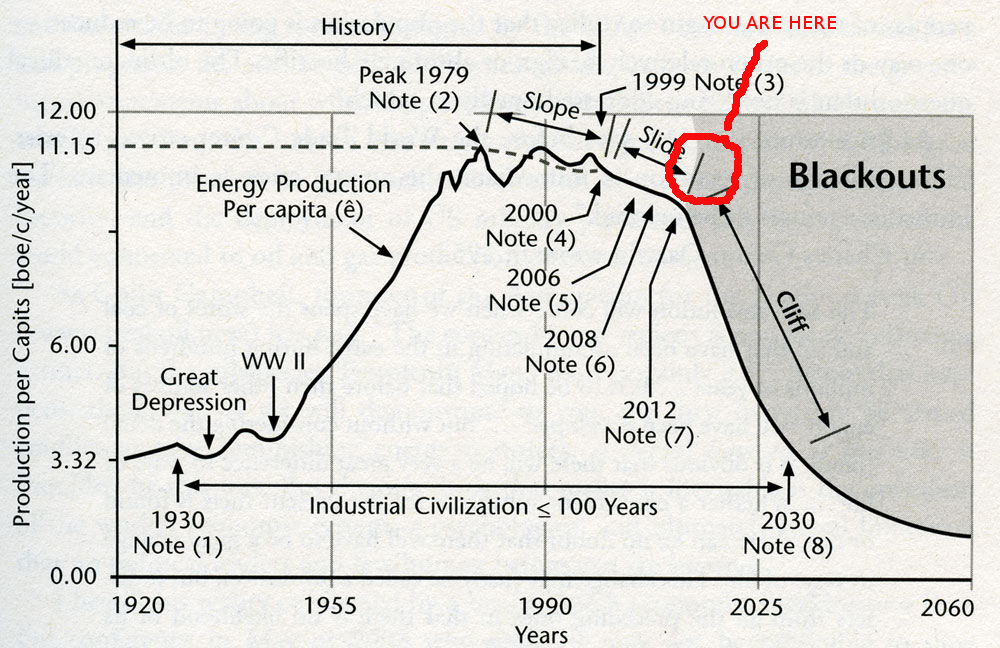
This chart appeared in Crossing the Rubicon in 2004 but was originally published in a book
called, The Oil Crash and You, by Richard Duncan…in 2001.

Occupy Fear and Loathing / Update ~ Santa Rosa

by Gabrielle Price

MIC CHECK!!!

We have not reached bat country yet – but have had the most amazing chance encounters while having the truck worked on here in Santa Rosa, California.

On December 17th, my intern and I had the distinct pleasure of interviewing Mr. Michael C. Ruppert at his home before heading back to Santa Rosa for truck repairs.  Footage is being edited as I type this and a teaser video is coming your way.

Last night, while waiting to hear back about the truck – we visited a local coffee shop owned by a family in the area.  We came across a local publication called the Sonoma County Peace Press, with the words “Why Occupy?” on the cover, Published by the Peace & Justice Center of Sonoma County.  After chatting with the coffee shop owners we found out the offices for the Peace & Justice center were within walking distance.

Arran walked down to ask if they would be interested in doing an interview with us and they were having a meeting.  We went down about half an hour later and sat in on a personal introduction session – where everyone shared some personal history about what brought them to the occupy movement.  It was very a very enlightening and emotional experience.

It was announced that the General Assembly was about to begin at the Santa Rosa City Hall grounds.  Several from this group left to attend and we walked toward City Hall a few blocks away to attend and take photos.

Much of the discussion focused on fundraising, with one of the ladies in the group sporting a handmade knit hat with the initials OSR [Occupy Santa Rosa] which is available for sale.

A spokesperson with the group that I had met at the Peace & Justice center, gave me the floor to announce our intent with the occupy Fear and Loathing media tour and to explain our predicament with the truck and the need for a safe place for the night.  The other spokesperson, Jackie, a former police officer, offered her home up for us to stay.

Jackie was scheduled to attend a meeting/discussion at a place called the Share Exchange, where there was a well known author who had been invited to talk about transition.  It was standing room only, however, so we grabbed some food nearby until we heard back that we could come in.  It was packed.

We had missed most of the discussion but found that many people in the room were highly in tune with the occupy movement and the transition movement.  The owner of the store explained how every product in the exchange was from local artisans, crafters and photographers only.  The tagline for the store is “…incubating the local community.”  It’s intent is to create local jobs, support local entrepreneurs and hosting events in a cowork space to encourage collaboration, resource sharing and to act as a regional model.

Jackie introduced us to several other people there and an announcement was made that a couple attending needed a place to stay with their young daughter.  Jackie immediately volunteered her home again as she made a connection with the little girl who was happily chatting up everyone in the store.

The evening ended with a caravan of us following Jackie to her home, nestled behind a green market in Healdsburg.  We shared a late meal and loads of interesting conversation with the folks who stayed with us.  One, a local builder and the couple; a Romanian storyteller and his wife and daughter.  We talked about everything from permaculture to mythology, to peak water and disaster capitalism.

Never before have I met such gracious, loving and intelligent people in one place, at one time, on one journey, with one collective mindset.

We all work for Gaia.  We all see what’s coming.  We are all working to prepare the ground for which we hope to see our children and grandchildren walk upon.  People realize that it will look much different than it does now or how it has looked in the past.  This is a frightening realization to many who have not begun to ask important questions, who have been asleep and have placed blind faith in a system that does not care for them or their future; let alone the future of this planet.

Every person involved in this movement should be looking within to ask if they are walking the path of their soul purpose, if their actions continue to keep the status quo in power.  Because make no mistake ~ a movement of the people is inherently a movement rooted in spirit.  This movement is bubbling up like a geyser and its spirit cannot be broken.

I’ll be sharing more details about this trip in the documentary film we’re making.  Please make a donation or purchase anything on this site so we may continue this work for the 99%.  For YOU.

Stay tuned for film teasers and more updates!
SOLIDARITY
Namaste ~ Gabrielle