
Official Excerpt from Crossing the Rubicon: The Decline of the American Empire at the End of the Age of Oil
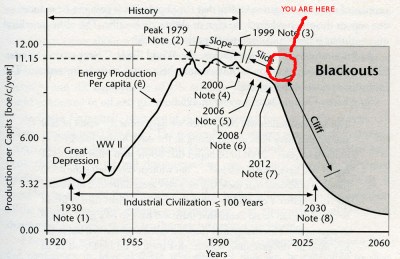
Take a 20-dollar bill out of your wallet and set it in front of you. Now take a glass of water and set it next to the cash. Pretend that the glass of water represents a barrel of oil. Look at them both for a second. Then ask yourself a question: What do they represent? If you keep distilling your answers down to their purest essence, you will see that the money and the oil both represent the same thing: the ability to do work. Both are useless if there is nothing to buy, drive or eat.
And yet our economic system, what we call capitalism but which is really something else, is predicated on debt, fractional reserve banking, derivative financing, and fiat currency. Therefore it requires that there must be limitless growth into infinity for it to survive. Growth is not possible without energy.
Now look at the barrel of oil and realize that the earth is a closed sphere, and that without the oil and natural gas, the financial system is doomed. There is nothing on our horizon – other than wishful thinking – that can completely replace hydrocarbon energy. The surest way to see this is to realize that, as the human race starts down the inevitable slope of shrinking oil and gas supplies, we have seen no hydrogen powered F 18 Hornets or M1 Abrams tanks. We have seen no vegetable oil-powered Bradley fighting vehicles or solar powered guided missile frigates.
There are many factors that the rulers of the American empire now have to manage as they read their own delusional map of the world. They have to:
- Apportion dwindling resources among competitors, some of whom possess nuclear weapons;
- Maintain and expand their control over enough of the oil and gas remaining to ensure their global dominance and maintain order among the citizens of the Empire;
- Simultaneously manage a global economic system, made possible by hydrocarbon energy, that is collapsing and in which the growing population is demanding more things that can only be supplied by using still more hydrocarbon energy;
- Acknowledge that they cannot save their own economy without selling more of these products;
- Control the exploding demand for oil and gas through engineered recessions and wars that break national economies;
- Hide the evidence that they are systematically looting the wealth of all people on the planet – even their own people – in order to maintain control;
- Maintain a secret revenue stream to provide enough off-the-books capital for purposes of providing themselves a distinct economic and military advantage, improving their technological posture, and funding covert operations;
- Repress any dissent and head off any exposure of their actions;
- Convince the population that they are honorable;
- Kill off enough of the world’s population so that they can maintain control after oil supplies have dwindled to the point of energy starvation.
In the case of the War on Drugs, I infer that the result of some 30 years of effort, fueled by billions of dollars and managed by the “best and the brightest,” is exactly what was intended. This is the premise from which I began looking at the events of September, 11, 2001, as I watched the second airliner hit the World Trade Center.
I do not claim to have presented or reconciled every fact. That rarely happens in a complicated homicide investigation. The tasks of the investigator are to produce a reasonable explanation based upon evidence that establishes probability, and to eliminate reasonable doubt that a crime was committed and that the guilty have been successfully identified.
If I can make a case in this book that explains these events, identifies the suspects, and makes more sense than any other interpretation of the available and demonstrable facts; if I can then get it out in a way that further empowers our collective learning; if that helps to break down the destructively false paradigm that governs so much of our life today – then I have contributed something that is hope-giving for all of us. Otherwise, the future looks pretty grim. This is a race against time.
Michael C. Ruppert ~ April, 21, 2004

Got lifeboat?
The Refreshment Center is home of the
Official Excerpts from Crossing The Rubicon
Official Excerpts from Crossing The Rubicon

 Gabracadabra Studios